Wrong Knowledge Is Filling the Earth in Every Consumable Form — and Every Soul You Win Steps Straight Into It the Moment They Leave Your Church. Our Generation Cannot Continue to Run a Weak Believers' Foundation School.
"The earth shall be full of the knowledge of the Lord as the waters cover the sea." — Isaiah 11:9
The prophecy is being fulfilled — but so is its counterfeit. Every soul you win walks out into a world where wrong knowledge is dispersed in every consumable form: video, audio, text, Virtual Reality — targeted, personalised, and relentless. The command to make disciples has never been more urgent. And the Believers' Foundation School has never been more necessary.
"The earth shall be full of the knowledge of the Lord as the waters cover the sea."
— Isaiah 11:9
We are in peculiar times.
The prophecy of knowledge filling the earth is being fulfilled in our generation — but the wrong knowledge has also multiplied tremendously, and it is filling the earth at the same velocity.
It is now dispersed in every consumable form: video, audio, text, Virtual Reality experiences. The gates to knowledge once reserved for a level of maturity in past generations have been flung open — not only to younger audiences in age, but in maturity and understanding. We live in an age where even five-year-old cartoon programmes expose children to concepts once considered too advanced for them. An age where industry knowledge is abundantly available, whether for industries considered moral or immoral, constructive or destructive to society.
This is the world your new convert returns to every Sunday evening the moment they step outside your church doors.
Not a neutral world. Not an empty world waiting to be filled. A world already full — of voices, philosophies, ideologies, and systems of belief — all of it targeted, personalised, and designed to hold their attention, shape their thinking, and define their identity for them.
Every algorithm on every device they carry is already working. Every platform they scroll has already profiled them. The world is not waiting for your Foundation School to finish its announcement before it begins its own discipleship.
It has already started.
This is why the command of the Master — "Go ye therefore and make disciples of all nations" — must become an instruction that our generation holds as dear as life itself. A thousand times more urgently than any generation before us. The volume, velocity, and reach of every other voice competing for the souls of men demands nothing less.
And this is why the Believers' Foundation School — your BFC — must move beyond being just a unit in the church where you make routine announcements, send reminders, and try to see how many first-timers and new converts you can get to attend.
The BFC is not the only tool of discipleship in the church. It is, however, the entry point. The starting juncture. The place where a soul that has just come to Christ first receives the foundational knowledge of who they now are, what they now carry, the family to which they belong, and the possibilities of the new life in Christ.
As such, the BFC cannot be a weak unit in any church — whether of fifty members or five thousand. The stakes are identical. The soul of a new believer in a small congregation carries the same eternal weight as one in a megachurch, and deserves the same quality of foundation.
The BFC must be a formidable force in the church. Not a programme the church runs. A force the church carries.
Now let me bring this home to where you are standing right now.
You did it again last month.
The outreach was powerful. The altar call — the whole church rose to its feet. People streamed forward. You counted forty-three souls in a single evening. Forty-three.
You went home that night with something rare inside you — the kind of deep, quiet joy that doesn't need anyone else in the room to feel it.
But that was last month.
You've been counting ever since.
Week one: they were there, a little uncertain, but present. Week two: still coming, looking for something to hold onto. Week three — some faces started to thin. By week four, you stopped counting out loud because the number was embarrassing.
"Where did they go? Did I not visit enough? Did I not follow up fast enough? Was the new members' class not good enough?"
You told yourself it is just how it is. People come forward emotionally and drift back to their old lives. It happens to everyone.
But now you understand more fully why — because those souls who left did not drift into nothing. They drifted into a world that was ready to receive them. A world with its own structure. Its own consistent messaging. Its own discipleship system, running twenty-four hours a day on the devices in their pockets.
And your Foundation School — the place that should have met them at the entry point, the place that should have been the first strong voice in their new life — was not strong enough to compete.
"I'm winning souls and handing them straight back to the world — because I've built nothing strong enough to hold them."
That thought keeps you up at night more than you admit.
Meanwhile, you're still doing what you've always done. Two Sunday messages for new members. A few phone calls. An announcement or two. And then quietly watching the back door empty out one more time.
Your wife has noticed. She doesn't say much. But you've caught her face on Sunday mornings — scanning the seats, tracking the familiar new faces, trying to see if they're still there.
She loves this church as much as you do. That's why her silence on the subject says more than any conversation could.
You've been at this long enough to know the cost. Every convert who slips away is not just a number. It is a family that never got grounded. A testimony that never formed. A future worker who never found their place in the Body.
You've tried things. You'll tell me about them shortly. None of them stuck.
And now your next outreach is already being planned.
The question is not whether souls will come forward again — they will. The question is whether your Believers' Foundation School will finally be the formidable force that receives them, grounds them, and keeps them.
Drop everything you are doing now and listen to every word I'm about to say.
Because I'm about to show you how to make your Believers' Foundation School the formidable force your church — and this generation — demands it to be.
This method didn't come from a seminar I paid ₦150,000 to attend.
It didn't come from a bestselling church growth book with a foreign pastor's face on the cover.
It came from a quiet conversation at a regional ministers' meeting — from a man who had quietly built something most loud, fast-growing churches couldn't buy at any price: a church where people simply didn't leave.
The most effective discipleship systems in the African church weren't born in megachurch auditoriums. They were forged slowly, cycle by cycle, in modest halls by pastors who decided to build deep before they built wide.
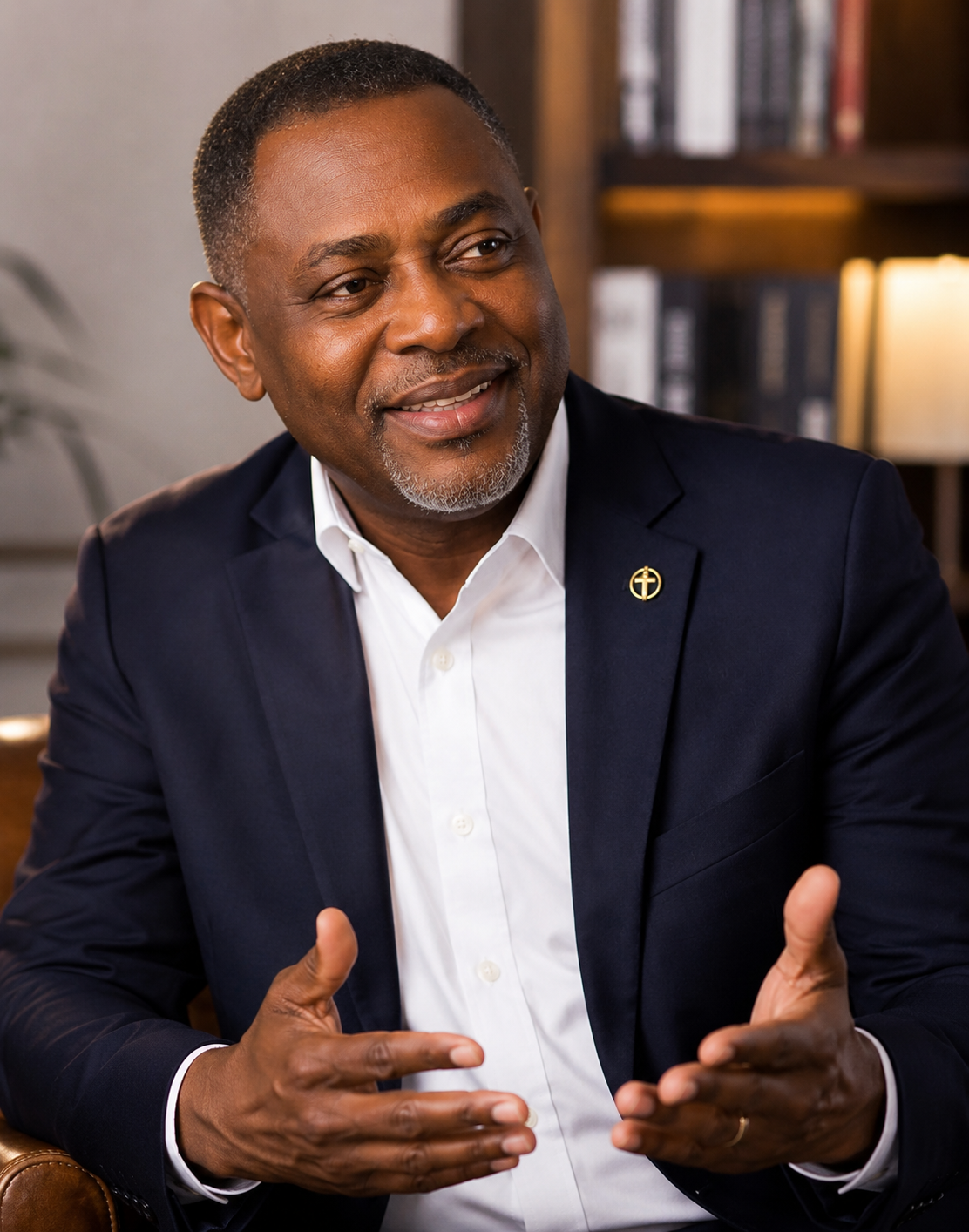
Hi. My name is Pst Michael Isaacs.
The first thing you should know about me is that I am not a church growth consultant. I am not a denominational expert. I don't run a ministry with thousands of members and a full-time discipleship team.
I am a pastor — like you — leading a young, growing church in Lagos, holding most of the ministry together myself, preaching every Sunday, doing outreaches on Saturdays, following up new converts in the evenings, and quietly carrying the weight of a church that kept winning souls it couldn't keep.
That was my life for four years. Until one afternoon changed everything.
— The Full Story
I planted this church six years ago in a rented hall in the Ikorodu corridor — just me, my wife Ngozi, and seventeen people who believed enough to show up every Sunday.
The early years were hard in the way early ministry is always hard: no money, no structure, no team, and a leader who was still figuring out who he was in God. But we prayed, we pushed, and the church grew.
By year three, we were doing outreaches. Real ones. Not just handing out tracts in front of the church — full-scale crusades, door-to-door evangelism, community events. And souls were coming forward. Every cycle, we'd have twenty, thirty, sometimes forty new converts declaring their faith.
It felt like growth. It looked like growth.
But something was wrong.
The membership number refused to climb. We were gaining at the front and losing at the back — and I couldn't understand why. I prayed about it. I fasted. I asked God what was missing in our spiritual atmosphere.
"Lord, are we doing something wrong in worship? Is the preaching not connecting? Do we have the wrong people on ushering?"
I was asking all the wrong questions.
The breaking point came after a particularly powerful crusade. We had sixty-one people come to the altar in one night. I will never forget that evening — the altar was packed, people weeping, workers praying with them, the whole church electric with something real.
Six weeks later, I sat in my office and counted. Eleven were still attending. Eleven out of sixty-one.
I put my head in my hands and for the first time in six years of ministry, I asked myself the question I had been avoiding: "Am I building a church, or am I running a revolving door?"
My wife came into the office that evening and saw my face. She sat across from me and after a long silence she said, gently — "Michael. We have to do something different. This can't keep happening."
She was right. And I knew it.
I tried everything.
First, I reached out to a larger ministry in our district and borrowed their Foundation School manual. It was impressive — thick, organized, colour-coded. I opened it on Monday morning with real hope.
I abandoned it by Thursday.
The manual was built for a church with a full-time admin team, a proper media department, and members who had been in church long enough to navigate denominational language. My new converts were barely holding a Bible. The gap was too wide. It gathered dust on my shelf.
Next, I assigned three of my most committed workers to personally follow up new converts. Phone calls, visits, WhatsApp check-ins. It sounded like a solid plan.
It lasted about two weeks.
The workers meant well. But they weren't grounded enough themselves to have the kind of conversations that anchor a new believer. Calls went unmade. Visits were promised and forgotten. One of the workers eventually confided in me: "Pastor, I don't know what to say to them. I don't want to push them away by saying the wrong thing."
So that fell apart too.
I ran my own two-Sunday new members' class. Just me, standing in front of whoever came, preaching salvation, the Holy Spirit, the importance of church attendance. No workbook. No progression. No way of knowing if they were absorbing anything. And after Sunday two — nothing. No clear next step. No graduation moment. They simply dissolved back into the general congregation and most of them kept drifting until they were gone.
I downloaded free resources — YouTube sermons on discipleship, free PDF guides from international ministries, podcast episodes from megachurch pastors. Good content. Genuinely inspiring. I'd listen with fire in my heart on Tuesday mornings...
...and by Wednesday evening, I was back in the same situation with no idea how to translate what I heard into something I could actually run in my church on Monday.
I even bought a generic Foundation School booklet from a Christian bookshop — a printed outline of basic doctrines. Salvation. Baptism. The Holy Spirit. Tithing. The Second Coming.
It was accurate. It was dry. It said nothing — absolutely nothing — about how to keep a person moving through those doctrines without losing them between sessions. It assumed the convert would stay. It had no plan for making sure they did.
Nothing worked. And I was running out of ideas.
The regional ministers' gathering that quarter was held on a Thursday afternoon in a hotel conference room on Lagos Island. Forty-something pastors. The programme was the usual mix of denominational updates, leadership discussions, and one or two strong sermons.
During a break — chai and small samosas, the kind of break where nobody really rests — I ended up standing near the window with a man I had seen at these gatherings before but never properly spoken to.
His name was Pastor Arthur.
He was in his sixties. Quiet. The kind of man who listened more than he spoke. He didn't lead the largest church in the room — not even close. But there was something about him. A settledness. Like a man who had built something that would still be standing long after the noise faded.
I don't know exactly how it came out. Perhaps I was tired. Perhaps I had been carrying it for too long. But standing there by that window, I heard myself say to this near-stranger:
"I keep doing outreaches and losing almost everyone we win. My Foundation School is not working and I don't know how to fix it."
I half-expected sympathy. A prayer. A referral to a good book.
Instead, Pastor Arthur looked at me for a moment and then asked one question:
"Is your Foundation School a programme your church runs — or a force your church carries?"
I opened my mouth to answer. And nothing came out.
Because I had no idea what the difference was. And in not knowing the difference, I realised — standing there with a cup of chai going cold in my hand — that I had never built a Foundation School. I had been running a programme. Something that happened on certain Sundays, when I remembered, with whoever came, until it quietly faded out.
Pastor Arthur saw it on my face. He nodded slowly, like this wasn't the first time he had watched a pastor arrive at that exact realisation.
"Come. Let me show you what I mean," he said.
We found a quieter corner. He pulled out a small notepad — the kind you'd see a much older generation of ministers use — and for the next forty minutes, he laid out something I had never seen in its entirety.
He told me that retention is not a follow-up problem. It is a vision and structure problem.
He said that when a Foundation School is treated as a department — a unit that makes announcements and gathers first-timers — it will always produce marginal results, because it is carrying marginal weight in the church's imagination. But when the Foundation School is treated as the engine room of the entire church — something that every leader, worker, and member sees as central, not peripheral — something changes. The school stops being a class the pastor runs. It becomes a force the church carries.
He quoted Isaiah 11:9 quietly: "For the earth shall be filled with the knowledge of the LORD, as the waters cover the sea." Then he said: "Pastor, the knowledge of the Lord does not fill a house by accident. It fills it by structure. Waters cover the sea because of a system — a tide that moves in and does not go back empty."
He showed me five things:
One: Cast the Foundation School as a force, not a class — in how you speak about it from the pulpit, in how the whole church sees it, in the language you use before, during, and after every cycle.
Two: Train a coordinator — someone who owns the school, not the pastor. A trained coordinator means the school runs even when the pastor is exhausted or travelling or stretched.
Three: Run a progressive curriculum — not a block of teaching, but a clear, stage-by-stage journey: Saved → Grounded → Baptised → Integrated → Serving. Every convert knows where they are and what comes next.
Four: Build a campaign plan — a deliberate intake system that fills the school at the start of every cycle, so it is never empty and never stale.
Five: Track every convert by name — so no one slips away unseen, and every absence is known before it becomes a departure.
"This is it? Just this?"
I didn't say it out loud. But I thought it. It felt almost insultingly simple for a problem that had kept me up for three years.
Pastor Arthur smiled as if he could read the thought. "The most dangerous thing about simple truths is that we keep looking past them for something more complicated."
I went home and told Ngozi about the conversation. She listened carefully and then asked: "So when are you starting?"
I started the following Monday.
The first two weeks were uncomfortable in the way all change is uncomfortable.
I had to speak about the Foundation School differently — not as "our new members class" but as something the whole church had a stake in. It felt strange in my own mouth at first. I wondered if the members would think I was just hyping something up.
But they didn't. They leaned in. Because they'd watched converts leave as long as I had, and they wanted something to change too.
I identified a coordinator — Sister Amaka, a quiet, methodical woman who had been faithfully serving in the church for four years. Not the loudest person. Not the most charismatic. But organised, warm, and deeply committed. I sat with her for three sessions and trained her on exactly what Pastor Arthur had shown me.
We ran the first cycle.
It was imperfect. Some sessions ran long. The tracking spreadsheet got muddled in week two. One convert stopped attending in week three and we almost missed it.
But by week six — the end of the first full cycle — something I had never seen happened.
A group of converts from one outreach were still there. Sitting in the same seats. Moving through the stages together. Knowing each other's names.
I stood at the front of the church on graduation Sunday and looked at twelve faces — twelve out of nineteen who had started — and I had to fight to keep my composure.
By the third cycle, something else happened. A visible group had not just stayed — they had joined departments. One man was helping in the sound booth. Two women had joined the prayer team. A young man who had come in off the street was now one of the most consistent workers in the church.
That is when Ngozi said the words I will never forget.
We were driving home one Sunday evening, and she turned to me from the passenger seat and said:
"Michael — do you realise the people who came at the last crusade are still here? I keep seeing the same new faces every Sunday now. It's the first time the church actually feels like it's holding people, not just gathering them."
I didn't answer immediately. I just drove.
Because that was the exact thing I had been praying for since year one.
Word moved quietly among the pastors in my network. At the next ministers' fellowship, two colleagues — Pst Femi from Mushin and Pst Blessing from Abule-Egba — pulled me aside to ask what I had changed.
Pst Femi implemented a version of the coordinator model and told me six weeks later: "I honestly didn't believe it would make that much difference. But my Foundation School ran without me for two full weeks while I was out of Lagos. It didn't collapse. It actually ran well."
Pst Blessing focused on the stage-by-stage curriculum and the campaign plan. She told me: "For the first time, my converts know where they are in the process. They're not just sitting in church hoping something sticks — they're moving. And they can feel the movement. That's what's keeping them."
Another pastor — a woman leading a small church in Ikorodu who had been on the verge of giving up outreaches altogether because she was "tired of winning people and losing them" — implemented the tracker. She sent me a voice note a month later, barely able to finish the sentence: "Pastor Michael... I can see all twenty-two of them. I know where each one is. I've never had that before."
These are not large churches. These are pastors like you — stretched thin, building in rented halls, carrying most of the ministry on their shoulders, desperate for something that will finally make their labour hold.
The system worked for them. It worked for me. And it can work for you.
After enough conversations like the ones above — pastors pulling me aside at meetings, WhatsApp messages at midnight asking "can you explain how the coordinator model works again?" — I knew I couldn't keep sharing this individually.
I documented everything. The full vision framework. The coordinator training process. The complete stage-by-stage curriculum. The campaign plan that fills the school cycle after cycle. The tracking system that makes sure no convert goes unseen.
I put it all — every principle, every structure, every practical tool — inside one toolkit that any pastor can open and begin implementing before their next intake.
Introducing...
Inside This Toolkit, You'll Discover:
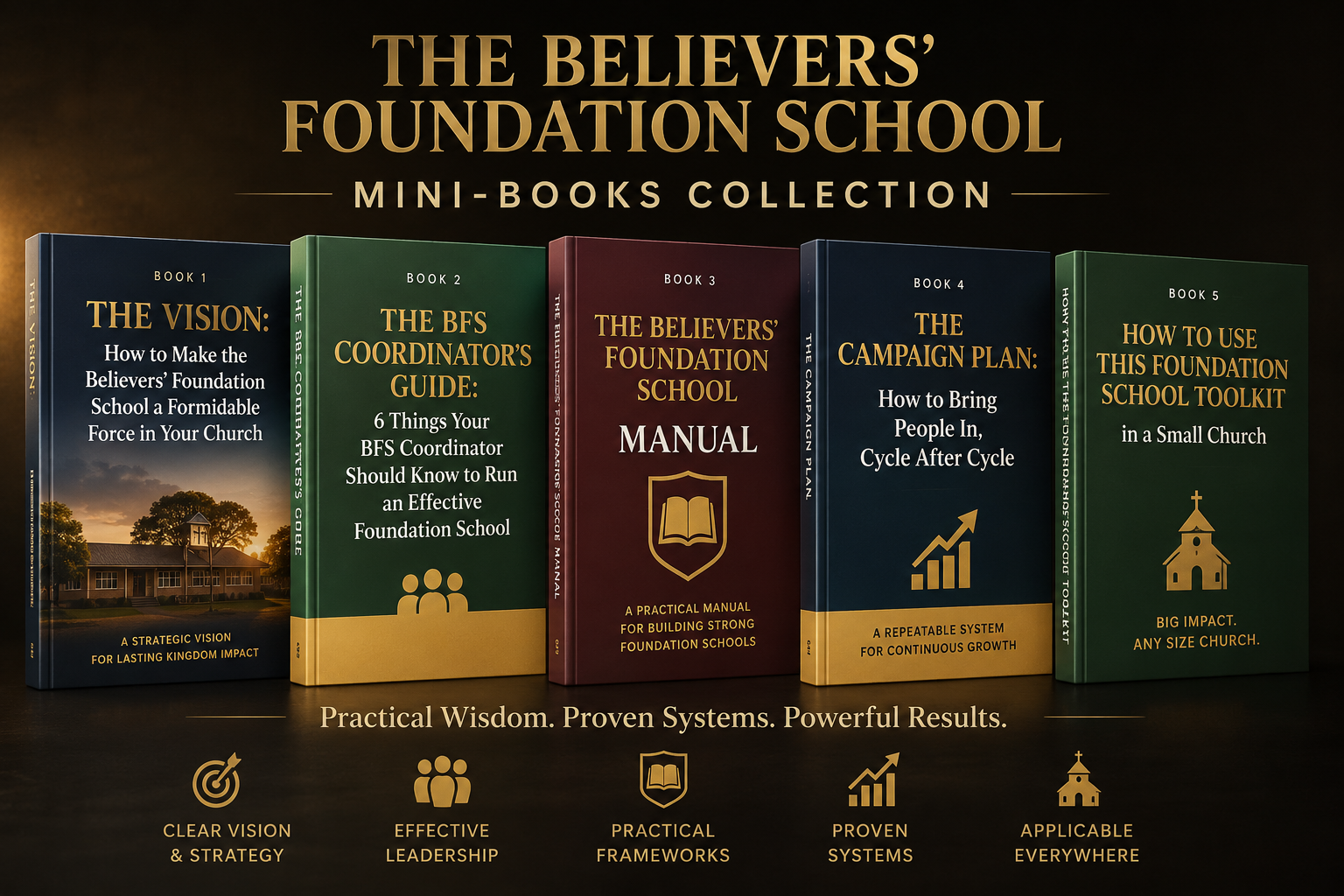
The Complete Believers' Foundation School Toolkit is a complete suite of mini-books designed to transform the Foundation School from a programme the church runs into a force the church carries.
The toolkit includes:
-
Book 1 — The Vision: How to Make the Believers' Foundation School a Formidable Force in Your Church.
Establishes the non-negotiable case for treating your Foundation School not as a departmental programme but as the discipleship engine of your entire church — with practical steps for casting this vision so that every leader, worker, and member carries it. -
Book 2 — The BFS Coordinator's Guide: 6 Things Your BFS Coordinator Should Know to Run an Effective Foundation School.
Everything your coordinator needs to own and run the school with confidence — so the Foundation School no longer depends on the pastor being present to function. -
Book 3 — The Curriculum: The Believers' Foundation School Manual (17 Classes).
A complete, ready-to-use stage-by-stage curriculum that moves a new convert through the foundational knowledge of who they now are, what they now carry, the family to which they belong, and the possibilities of the new life in Christ. -
Book 4 — The Campaign Plan: How to Bring People In, Cycle After Cycle.
A deliberate mobilisation strategy for filling the Foundation School at every intake — because mere announcements will not move people in a world already saturated with competing information. -
Book 5 — How to Use This Foundation School Toolkit in a Small Church.
Specifically written for young and growing churches — because the soul of a new believer in a congregation of fifty carries the same eternal weight as one in a megachurch, and deserves the same quality of foundation.
Together, these resources provide the vision, structure, curriculum, mobilisation strategy, and implementation framework required to build a Foundation School that is spiritually deep, operationally strong, highly effective, and built to last.
You do not need to be a megachurch pastor to implement this. You do not need a full-time discipleship team or an elaborate budget. Every book in this toolkit was built for the pastor who is doing the work in a real church, with real constraints, right now.
Real Pastors. Real Results.
Share Your Experience
Just So You Know...
This toolkit did not come together overnight. Here is what went into preparing it for you:
- Months of writing and structuring — turning field-tested principles into a clear, readable, pastor-friendly format that does not require a seminary degree to follow
- Multiple rounds of editorial review — ensuring every section is accurate, practical, and free of the kind of vague spiritual language that sounds good but helps no one on Monday morning
- Field-testing across multiple church cycles — the curriculum and coordinator model were refined through real implementation in real churches across Lagos and beyond, not assembled in a room and published
- Careful design, layout, and formatting — producing a toolkit that is not only useful but clear and navigable, with proper page structure, section markers, and a layout that makes it easy to return to specific sections
- Platform setup and distribution — the digital infrastructure that puts this toolkit in your hands within minutes of payment, ready to open and begin implementing immediately
Here Is What I Am Charging You For All of It
I won't charge you ₦200,000.
Not ₦100,000.
Not even ₦50,000.
A fair price for this system would honestly be ₦23,000.
But today — for pastors who act now — you are paying:
⚠ This discounted price is ONLY for pastors who decide today — before your next outreach brings souls you are not yet ready to keep.
⭐ WAIT — I Have FREE Gifts For You!
If you are among the pastors who act today, these powerful bonuses come with your toolkit — at no extra cost.
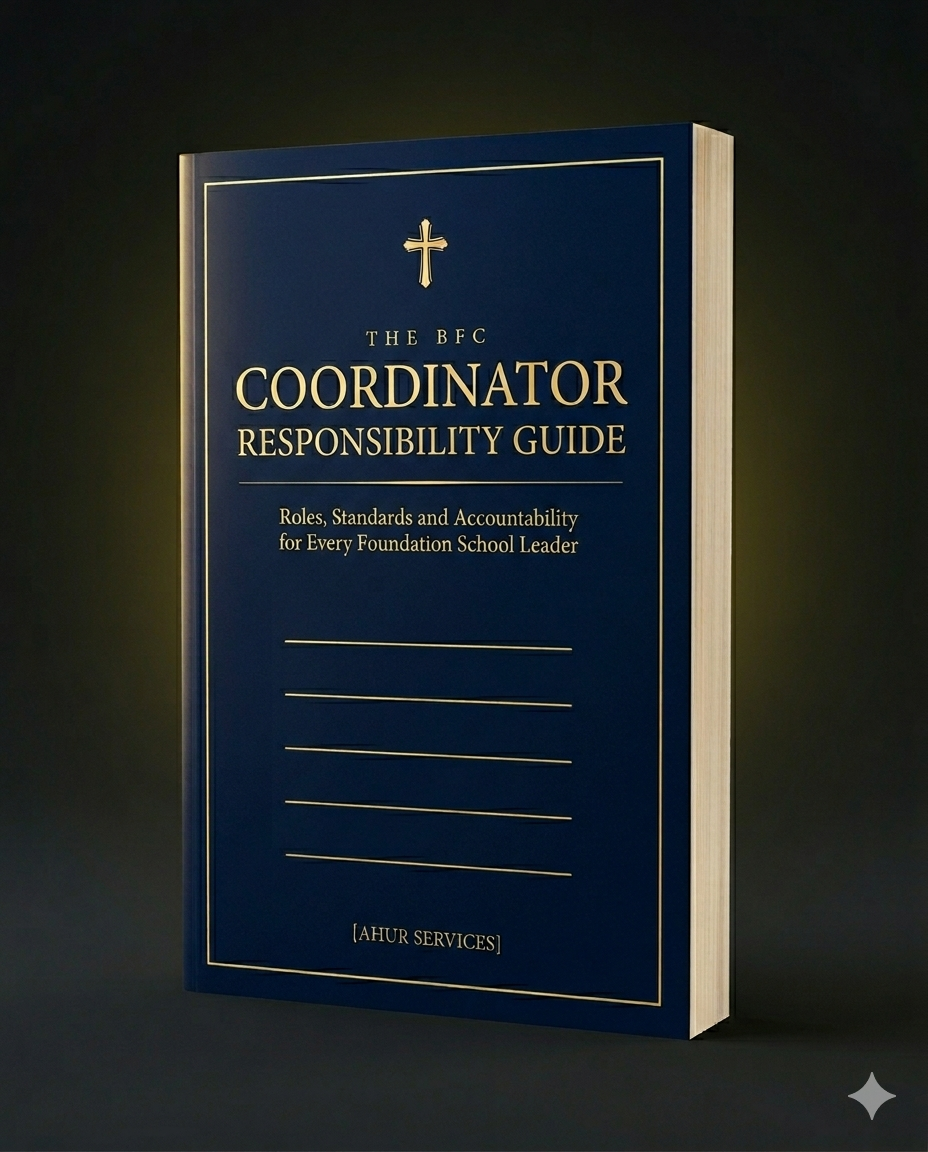
🎁 Bonus 1: The Coordinator's Quick-Start Brief
Everything your Foundation School Coordinator needs to begin immediately — without requiring weeks of training. Hand this to your coordinator and they will know exactly what to do, step by step. Your school runs without resting on your shoulders alone.
Value: ₦5,000 — Yours FREE
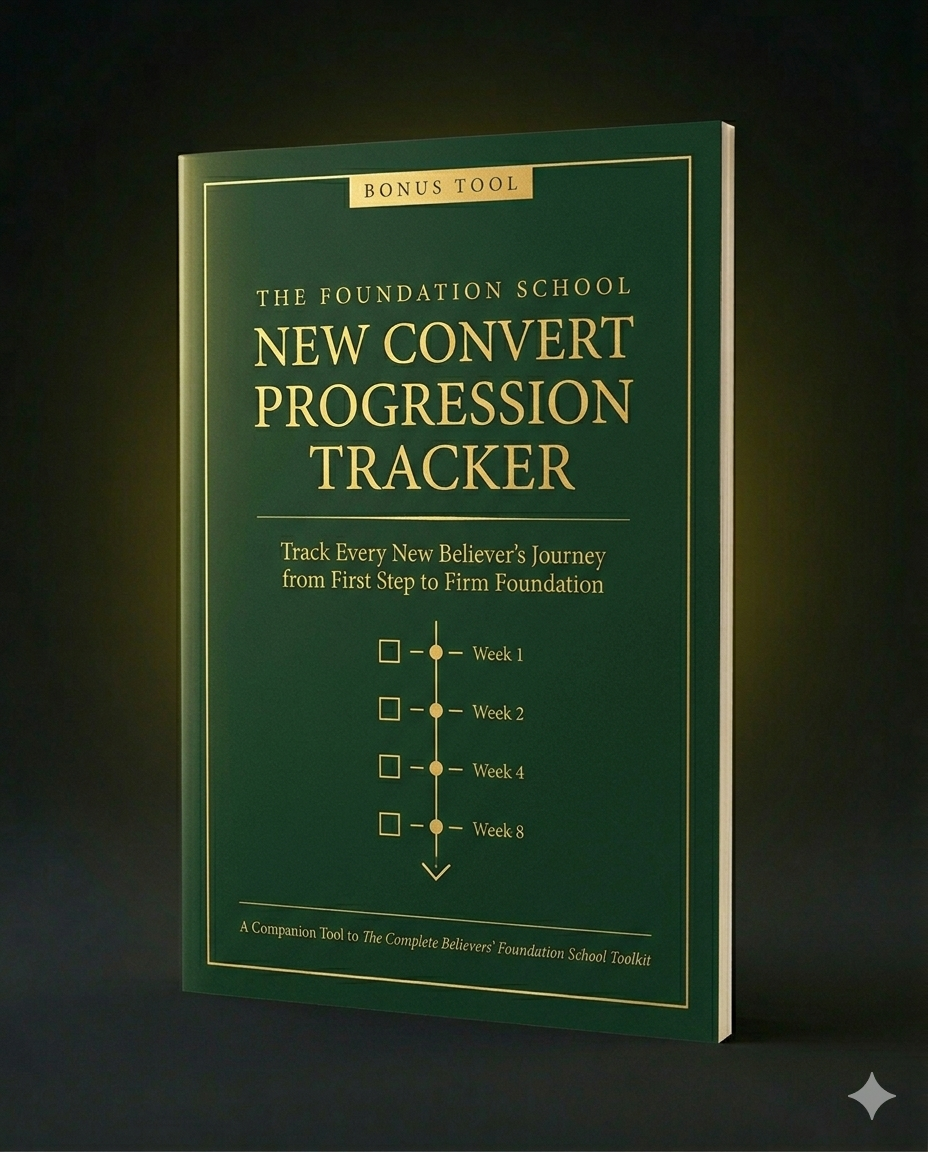
🎁 Bonus 2: The Convert Progression Tracker
See exactly where every new convert stands at any point in the cycle. Know who is on track. Know who has gone quiet before they disappear. No convert slips away unseen again — this tracker puts every name in front of you.
Value: ₦4,000 — Yours FREE

🎁 Bonus 3: Foundation School Campaign Template
A fill-in plan for running a full intake campaign cycle after cycle — because announcements alone will not fill your Foundation School. People are overwhelmed with information. This template shows you how to cut through and consistently bring people in.
Value: ₦6,000 — Yours FREE
These bonuses are for pastors who act — not the ones who bookmark the page and mean to come back.
Pastors Who Have Already Taken This Step
These are pastors across Africa who have received the toolkit and are already building.
73+
pastors have already taken this step.
Only a handful of slots remain at this price.
You are not the only one viewing this page right now.
Have a question before you buy? We are here.
💬 Speak To Someone on WhatsAppMore Pastors. More Results.
Pastor, There Are Only Two Roads From Here
✅ Option 1: Act Today
Get The Complete Believers' Foundation School System. Restructure your Foundation School before your next intake. Watch your converts move through the stages and stay — sitting in the same seats, joining the same departments, becoming the grounded disciples you laboured to win. Stop running the revolving door. Build something that holds.
❌ Option 2: Wait
Close this page. Go back to the two-Sunday new members' class. Run another outreach. Win more souls. Watch the back door empty out one more time. Keep counting down from forty to nine to four. Maybe next time will be different — but you know, deep down, that nothing changes until something changes. The question is when you decide to change it.
Your next outreach is already coming. The only question is whether you'll be ready for the souls it brings.
The clock is ticking.
Secure checkout via Selar · Card, Bank Transfer & USSD accepted · Instant digital delivery
Questions? Chat with us on WhatsApp