Family Systems Analyst and Mother Reveals a Simple 21-Day Home Reset That Helps Nigerian Mothers Finally Get Peace in Their Own Home — Even When Flogging Has Failed, Talking Has Failed, and You're Starting to Wonder Where You Went Wrong

Olamide Deji-Williams, Family Systems Analyst | Houston, TX
You woke up this morning already tired.
Not tired from sleep. Tired from yesterday. From the argument at breakfast. From calling his name four times before he even looked up. From the eye-roll she gave you when you asked her to put her plate away.
Is this normal? Am I doing something wrong?
You go to work and hold it together. Your colleagues think you are sharp, composed, reliable. You are. Outside that house, you are a different person.
But inside that house — the house you are working hard to maintain, the house where you cook and clean and show up every single day — your own children treat your instructions like background noise.
You ask once. Nothing. You ask again, louder. They move slowly, like they are doing you a favour. You raise your voice. They comply for twenty minutes. Then everything resets.
Like nothing happened. Like I said nothing at all.
You have tried flogging. It worked for two days and then something hardened in them and it stopped working entirely.
You have tried talking — long, patient conversations about respect and values and what your mother would say if she saw this. They nodded. They apologised. They changed nothing.
You have taken the phone. That triggered the kind of argument you are still recovering from.
Your mother calls from Lagos and you do not tell her the full truth because you cannot bear to hear her say "na you spoil them." Your husband says you are too soft. Some days you wonder if he is right. Other days you are too exhausted to wonder anything at all.
Where did I go wrong? These are my children. Why are they treating me like this?
You are not a bad mother. You are a mother whose home has lost its structure — and nobody taught you how to rebuild it.
Drop everything you are doing now and listen to every word I am about to say.
"Because I'm about to share with you a simple 21-day reset system that changed everything for me — and has since changed everything for hundreds of Nigerian mothers who were exactly where you are right now."
This is not something I found in a Western parenting book. It is not advice from a therapist who has never set foot in a Nigerian home. It is not a viral Instagram post about "gentle parenting" written for a different world entirely.
This is a system I built myself — from scratch, from desperation, from the kind of quiet professional clarity that only comes when you have run out of every other option.
Hi. My name is Olamide Deji-Williams.
First thing you should know about me is that I am not a celebrity parenting expert. I am a Family Systems Analyst — which means my job, professionally, is to look at broken structures, find where they failed, and design protocols to rebuild them. What I did not expect was that the most broken structure I would ever have to fix was the one inside my own home.

Olamide, at her kitchen table in Houston — where the system was born.
I grew up in Gbagada, Lagos. My mother never had to ask twice. Not once. When she called your name — once, in that tone — you appeared. You greeted. You cooperated. Not out of fear, exactly. Out of a structure that was simply the air we all breathed in that house.
I assumed I would have that same home one day. I did not.
By the time my son Kunle was twelve and my daughter Tolu was nine — still back in Lagos, before we ever relocated — something had already started to shift. I would ask Kunle to greet a visitor and he would stay glued to his screen as if I had not spoken. I would tell Tolu to go and bathe and she would say "I will" — and then simply not move.
When I raised my voice, they would comply for twenty minutes and return to exactly what they were doing before. When I took the phone, there were tears, arguments, and door-slamming — and the moment it came back, the behaviour came back with it.
I told myself it was a phase. It was not a phase.
I blamed the new school. Then the neighbourhood children. Then the fact that my husband Michael travelled frequently and I was managing the home largely alone. I kept looking for an external reason because the alternative — that something had broken inside my own home, under my own watch — was too painful to look at directly.
When we relocated to Houston, what had been a slow leak in Lagos became a flood. Not because of America. Because I had spent two years not knowing how to stop it, and time had compounded everything. There was no grandmother nearby to back me up. No aunty dropping in to restore order just by walking through the door. It was just me, and a home that was quietly slipping out of my hands.
I was working full-time. Active in my church. Considered composed by everyone around me. And completely falling apart in my own kitchen.
The morning that broke me was ordinary. I asked Kunle to clear his plate from the breakfast table before leaving for school. He looked at me — looked directly at me — and walked out the door. Not in defiance. Not even with attitude. He simply did not register that I had spoken.
I stood in the kitchen for a full minute. Then I sat down on the kitchen floor and cried. Quietly. The kind of crying you do when you have been holding something in your chest for so long that it finally just runs out of room.
This is my child. This is my home. How did we get here?
I had tried everything by then. Let me be honest about what did not work:
Shouting and repeated warnings. Produced short-term compliance and long-term immunity. The children simply learned to wait out the storm. After enough storms, they stopped flinching.
Flogging. Created fear in the moment and quiet resentment that surfaced as worse behaviour within days. Something in the relationship shifted — a distance I could feel but not name.
Taking away screens and devices. Triggered the most explosive arguments in the house. The moment the device returned, the behaviour returned with it. I was fighting the symptom, not the cause.
Long emotional conversations about respect and values. Tolu and Kunle would agree to everything, apologise sincerely, and change absolutely nothing by the following morning. I was giving them practice at performing remorse, not building actual respect.
Asking Michael to step in and be stricter. Produced two weeks of raised voices and a household atmosphere so heavy I eventually backed down just to restore peace. We ended up further apart as a couple and the children had simply learned to ride out the disruption.
Nothing. Worked.
Then one night, after the children were in bed and the house was finally still, I sat down at the kitchen table with my notebook — the same notebook I use professionally — and I did something I had been too emotionally overwhelmed to do for two years.
I stopped asking "what is wrong with my children."
I started asking the question my training had always taught me to ask first: "Where did the structure break down — and what would it take to rebuild it?"
That shift in question changed everything.
I did what I do professionally. I mapped the authority structure of our home. I identified the exact moments and habits that had gradually trained my children to stop taking me seriously. I traced every failed intervention back to a root cause. And then I designed a reset protocol — the same way I would design one for a broken organisation. Except the organisation was my home. And the people I was trying to reach were my own children.
I called it the 21-Day Home Authority Reset. I did not tell Michael what I was doing. I just started.
The first few days felt like nothing was happening. I almost stopped. I almost told myself this was just another thing that wasn't going to work.
Then Day 5 happened. I asked Kunle to set the table for dinner. He grumbled. But he got up. No second call. No argument. I said nothing. I registered everything.
By Day 9, Tolu had started responding to the first call at least four times out of five. Small. But the structure was beginning to hold.
Day 13 was the moment I knew. I gave an instruction to both children simultaneously, in a calm voice. Both complied within two minutes. No negotiation. No second call. I walked to my bedroom, closed the door, and stood there quietly because I did not want them to see me cry.
By Day 21, the home felt different in a way that is difficult to explain. Not perfect. Not without friction. But ordered. I was no longer managing chaos. I was running a home.
Michael noticed around Day 8. He was the one who had told me for months that I was too soft. Around Day 12 he came into the kitchen and said quietly: "I don't know what you're doing differently but please don't stop."
He never acknowledged that his approach had also contributed to the problem. I did not need him to. The home was changing and that was enough.
After I shared what I had done with three other Nigerian mothers in my Houston community, they came back weeks later saying their homes had shifted. Adaugo in Gbagada told me: "By week two my son started greeting visitors without being reminded. I nearly fainted." Chisom in London said: "My daughter and I had not had a peaceful dinner in months. By Day 10 we were eating together without one argument." Folake in Toronto: "Something shifted in my son. I could feel it."
That is when I knew I needed to stop sharing this informally and package it properly — so that any Nigerian mother, in Lagos or in London, could access it without needing to call me.
Introducing
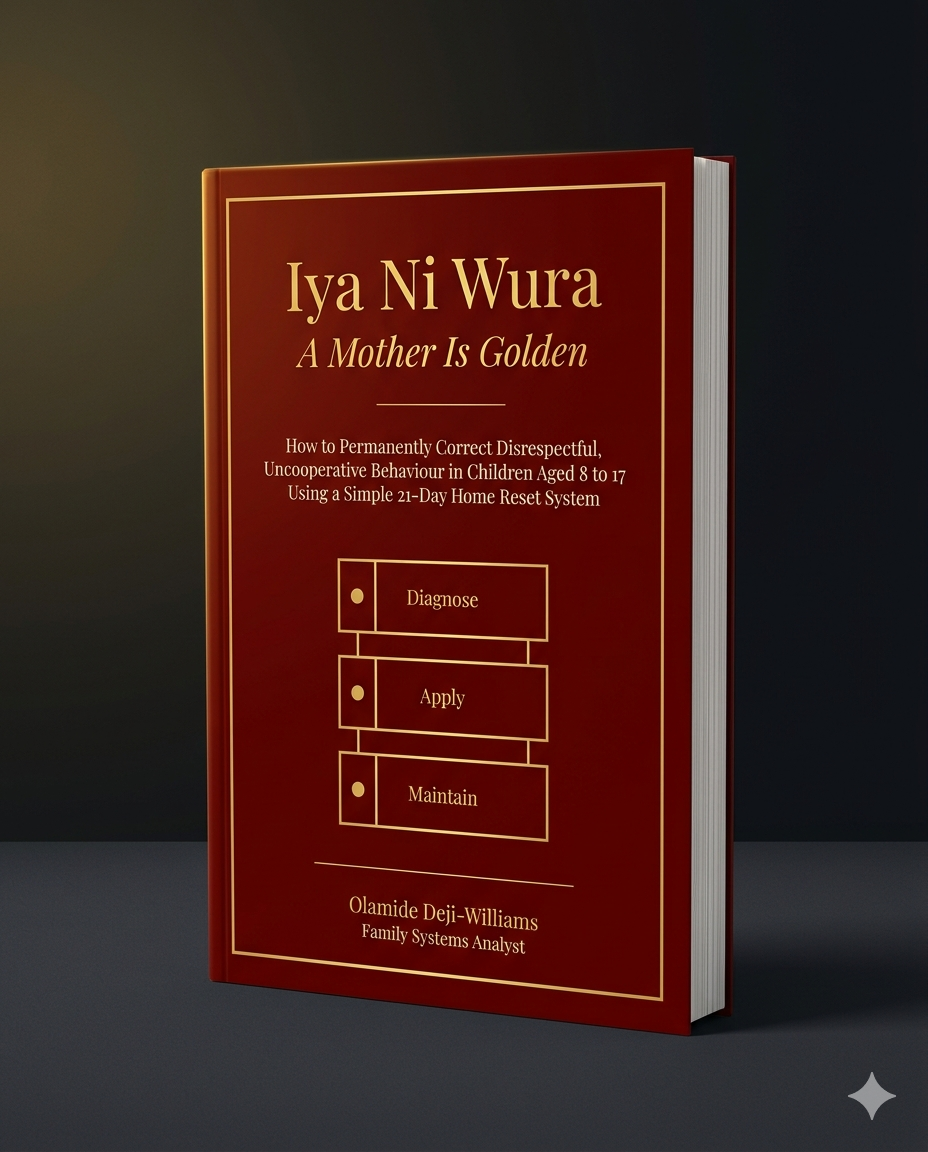
Iya Ni Wura — A Mother Is Golden:
The 21-Day Home Authority Reset for Nigerian Mothers
I put everything inside one simple PDF guide — the full 21-day system, the diagnostic checklist, the exact scripts, the consequence framework, the screen boundary protocol, and the weekly reset ritual. Everything I used. Everything that worked. Written in plain, warm, conversational English for the Nigerian mother navigating the collision between traditional values and modern child behaviour.
No jargon. No Western theories that do not apply to your home. Just the system. Day by day. For 21 days.
Inside This Guide, You Will Discover:
- The three forces that silently eroded your authority — screen culture, the widening authority gap, and the discipline habits that accidentally trained your child to tune you out. You will finish this section feeling understood, not blamed.— Pg. 4
- The Authority Gap Diagnostic — a 10-question checklist that shows you exactly where the breakdown happened in your home, so that everything that follows feels personally targeted at your situation.— Pg. 9
- The exact conversation to have with your child — when to have it, what to say word for word, and how to say it — that quietly shifts something in how they see you, without shouting, without threatening, and without them even realising what just changed.— Pg. 15
- What to do in the moment your child defies you — a ready-to-use list of consequences that actually land, that your child cannot laugh off or wait out, written for the Nigerian home and the Nigerian child specifically.— Pg. 28
- How to end the phone war for good — not by taking the phone and starting a battle, but by using one simple written agreement that makes your child police their own screen time so you are no longer the villain every evening.— Pg. 36
- What to do when the respect starts slipping again — because it will — and how to catch it early and reset it quietly before your home is back where it started.— Pg. 45
And the best part? You do not need to shout, threaten, or beg. You do not need your husband's cooperation. You do not need your child to suddenly decide to be different. It is the same simple system that worked in my home — and has now worked for over 200 Nigerian mothers I have quietly shared it with.
Real Mothers. Real Results.
What Nigerian mothers are saying after completing the 21-day reset
Honestly I was sceptical because I have bought things before that didn't work. But by Day 9 my son greeted my neighbour without me saying a word. Ehn! I nearly called Olamide to shout. This guide is different because it understands our home. Not oyinbo parenting. OUR home.
My daughter and I were fighting every single morning before school. Homework, phone, what to wear — everything was a battle. By Day 13 we had three mornings in a row with no argument. Three! I did not know what to do with myself.
As a diaspora mum raising my children in London, I was struggling with the gap between what I was taught and what people here say about parenting. This guide bridged that gap perfectly. My son is 14 and he now responds the first time. First time! That is all I can say.
My husband thought I was wasting money. By Day 17 he came to me and asked what I bought because the children had changed. I just smiled. This guide is worth ten times what she is charging. Buy it now before she changes her mind about the price.
I am also in Houston like Olamide. Nigerian mother raising kids here is not easy at all. This guide gave me a system I could hold onto even when everything around me was pushing back. Day 21 I cried. Genuine tears. My home is mine again.
Just So You Know… Putting This Guide Together Cost Me Over ₦180,000
- 18 months of professional systems analysis and framework development applied to a parenting context
- Cultural research and consultation across Nigerian homes in Lagos, London, Houston, and Toronto
- Multiple rounds of real-home testing — adjusting, refining, running again until the system held
- Professional writing, editing, and layout design to make the guide readable and beautiful
- Platform development and hosting so that mothers everywhere can access the guide instantly
I am not going to charge you ₦180,000… I will not even charge you ₦50,000… Not even ₦25,000… In fact, you will not even pay the original listed price of ₦9,800.
🔒 Secure payment via Selar · Card, Bank Transfer, or USSD · Instant access after payment
WAIT! I Have a FREE Gift For You…
If you are among the first 30 mothers who pay today, you will receive these two bonuses alongside your guide. Today only.
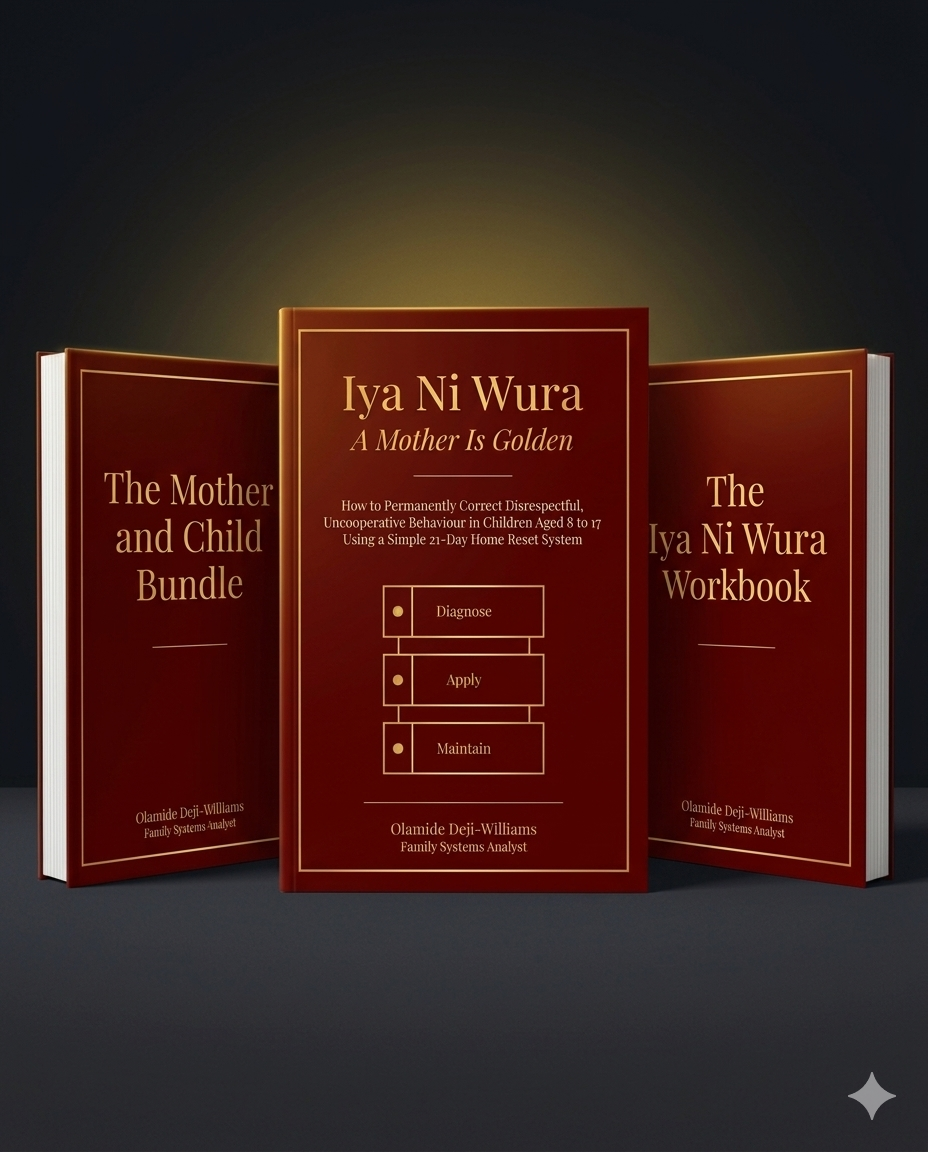
The Iya Ni Wura Workbook
A 21-day action companion that turns the guide into a daily practice — so you stay accountable, track your progress, and never lose momentum across the full reset. Five minutes per day. Simple daily prompts. A record you can look back at on Day 21 and see exactly how far your home has come.
The Mother & Child Bundle
A 3-in-1 toolkit: Daily Declarations for My Child — 21 identity-shaping declarations to speak over your child each day. My Mirror Book — 21 daily affirmations to rebuild your own confidence as a mother. This Is My Home — a printable family declaration for your wall so the values repeat themselves without you having to.
First 30 mothers only · ₦3,500 today · Price returns to ₦9,800 after
See Who Just Joined
Iya Ni Wura Buyers
247 members · 18 online23 mothers have already taken advantage of this discount today…
Only 7 slots remaining at ₦3,500.
Bear in mind — you are not the only one viewing this page right now.
Only 7 left at this price · After that it returns to ₦9,800
My Bold, Risk-Free Promise to You
I am not asking you to trust me blindly. I am asking you to trust the system for 21 days.
Follow the guide. Take one action every day for 21 days exactly as the reset instructs. If your home has not shifted — send me one message and I will refund every kobo.
If your home hasn't shifted in 21 days, send me one message and I will refund every kobo — no questions asked.
Yes — I Want Peace In My Home. Get The Guide!More Mothers. More Results.
These women were exactly where you are. Now their homes have changed.
I have a 16-year-old son and I was at my wit's end. I had tried everything including sending him to my mother for two weeks — he came back the same. This guide is the first thing that made actual, lasting difference. The consequence system alone is worth ten times the price. Iya ni wura indeed.
As a single mother in Toronto I needed something I could do alone, without waiting for anyone to back me up. By week two my daughter had stopped the door slamming. By week three she was coming to tell me about her day. I don't fully understand what happened but I am not questioning it.
The Daily Declarations in the bonus alone have changed something in me. The way I see my children. The way I speak to them. Something shifted in me before it even shifted in them. That was not what I expected when I bought this guide but it is the gift I needed most.
Day 5 my son called me "Mummy" in that soft voice he used to use when he was small — I had not heard that voice in almost two years. I know that sounds small but if you are a Nigerian mother you know exactly what I mean. Buy this guide.
What I love most is that this guide does not ask me to choose between being a Nigerian mother and being a modern mother. It holds both. It understands both. I have recommended it to six women in my church and all six have come back to say thank you. That tells you everything.
Before You Close This Page — Consider Two Options:
Option 1: Take action. Get the guide. Complete the 21-day reset. And reclaim genuine respect, daily cooperation, and peace in your own home — the same home you work so hard to maintain every single day.
Option 2: Close this page and keep doing what has not worked — the shouting, the flogging, the phone removal, the tearful conversations that change nothing by morning. Keep wondering where you went wrong. Keep holding it together outside and falling apart inside.
Maybe God wanted you to see this page today. Maybe it is not a coincidence that you are here. Who knows?
⌛ The clock is ticking. Only 7 slots remain at ₦3,500.
🔒 ₦3,500 only · Instant access · 21-day money-back guarantee · First 30 mothers only
Iya Ni Wura. A Mother Is Golden.
Share Your Experience